
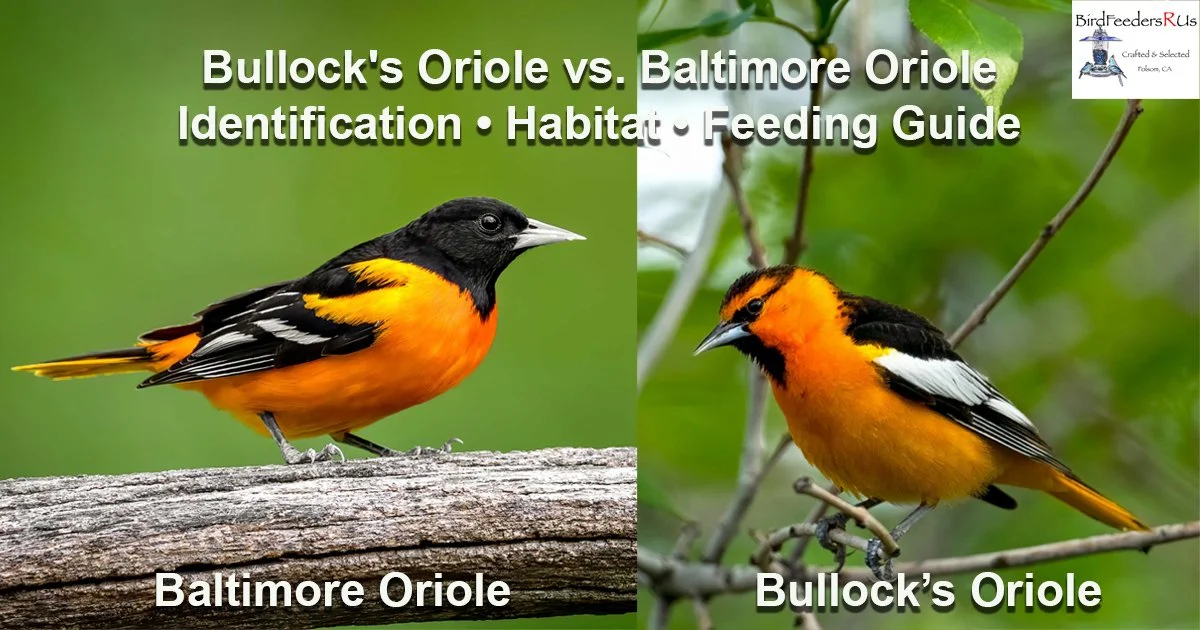
Photos Courtesy of iSockphoto.com
Compare the Key Differences
Have you spotted a brilliant orange-and-black oriole in your backyard but aren't sure whether it's a Bullock's Oriole or a Baltimore Oriole? While these colorful songbirds look remarkably similar, they live in different regions of North America and have several key differences in appearance, nesting habits, migration, and behavior.
This complete identification guide will help you tell them apart, understand where each species lives, discover what they eat, and learn how to attract orioles to your backyard using the right feeders and foods.
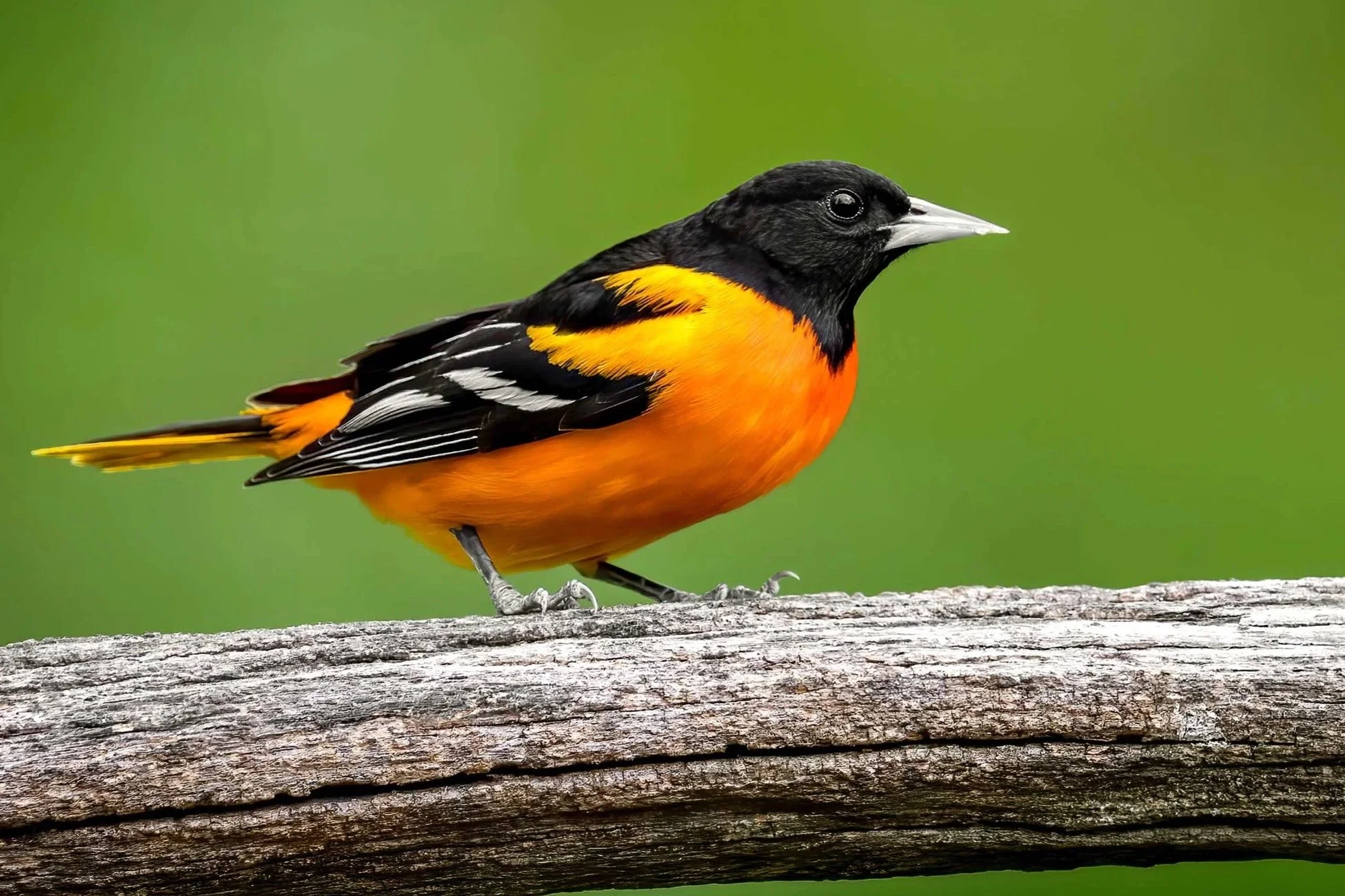
Male Baltimore Oriole
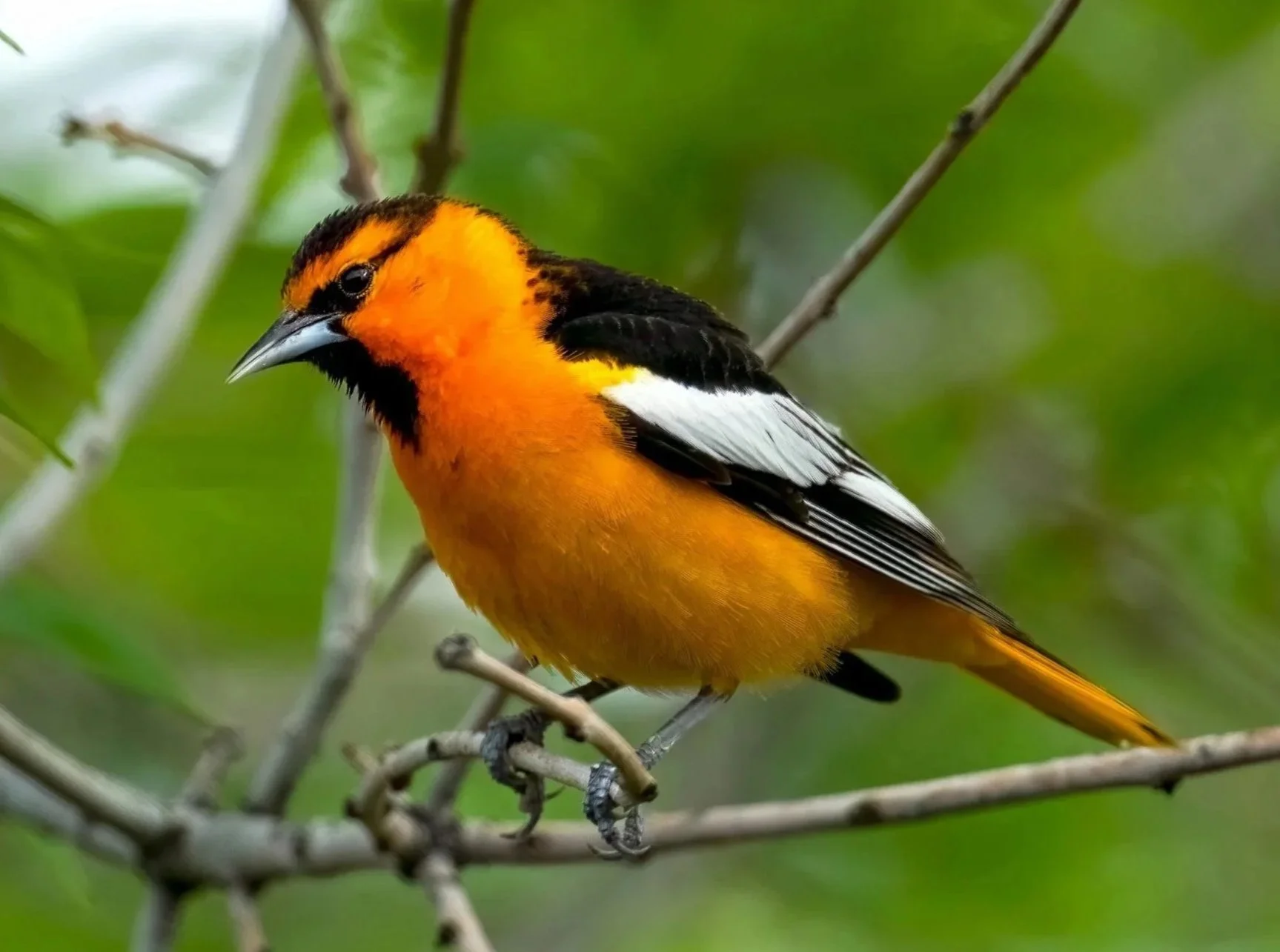
Male Bullock’s Oriole
Identification
Bullock's Orioles (Icterus bullockii) and Baltimore Orioles (Icterus galbula) look remarkably similar. Both males display brilliant orange plumage with black backs and white wing patches, making them two of North America's most colorful songbirds. However, a closer look reveals several important differences.
The easiest way to distinguish the two species is by looking at the face. Male Baltimore Orioles have a solid black hood that extends over the head and throat, creating a bold, unmistakable appearance. Male Bullock's Orioles have an orange face with a distinctive black line running through the eye and a black crown, giving them a more open-faced look.
Their wing patterns also differ. Bullock's Orioles typically show a larger white wing patch, while Baltimore Orioles display two thinner white wing bars. These markings are often the quickest field marks when observing birds through binoculars.
Females and immature birds can be more challenging to identify because both species have yellow-orange bodies with grayish backs. In these cases, location becomes one of the best clues, since Bullock's Orioles are primarily found in western North America, while Baltimore Orioles are most common in the east.
Although the two species have separate breeding ranges, they occasionally overlap in the Great Plains, where they are known to hybridize naturally. This unique overlap can make identification even more interesting for birdwatchers.
Habitat & Range
Bullock's Orioles and Baltimore Orioles occupy different regions of North America, making location one of the easiest ways to identify which species you're seeing.
Bullock's Orioles are found primarily throughout the western United States and southern Canada during the breeding season. They prefer open woodlands, cottonwood groves, riparian corridors, parks, orchards, and suburban neighborhoods where tall deciduous trees are present.
Baltimore Orioles breed across the eastern United States and southern Canada. They are commonly found in mature deciduous forests, river bottoms, shade trees, parks, and residential neighborhoods with large hardwood trees such as elms, maples, and oaks.
Although their breeding ranges are largely separated, the two species overlap across portions of the Great Plains from the Dakotas south through Nebraska, Kansas, Oklahoma, and parts of Texas. In these areas, Bullock's and Baltimore Orioles occasionally interbreed, producing naturally occurring hybrids.
During migration, both species travel south into Mexico, Central America, and the Caribbean before returning north each spring.
Outside of the breeding season, birds may occasionally appear well outside their typical range, making identification based on plumage especially important.
Range Maps & Migration
The maps below illustrate the breeding, migration, and winter ranges of Bullock's and Baltimore Orioles across North America. Although their primary breeding territories are separated by geography, the two species overlap in portions of the Great Plains, where natural hybridization occasionally occurs.
Understanding these ranges is one of the easiest ways to identify which oriole you are likely to encounter in your backyard. Birdwatchers in the western United States are far more likely to see Bullock's Orioles, while those in the eastern states typically observe Baltimore Orioles. During spring and fall migration, however, both species may be seen outside their normal breeding ranges.
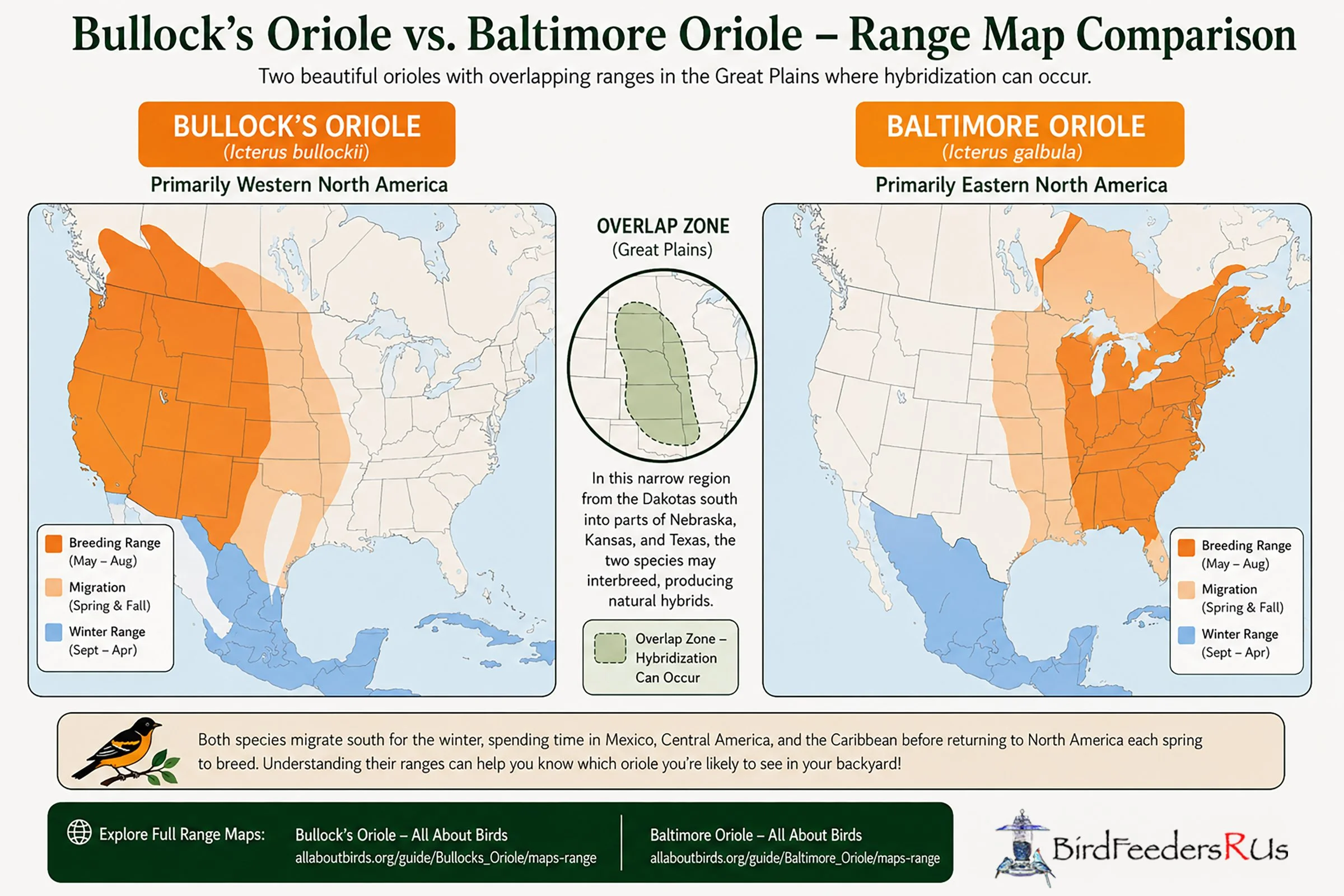
Comparison of Bullock's and Baltimore Oriole range maps showing their breeding, migration, and winter territories across North America. The two species overlap in portions of the Great Plains, where natural hybridization can occasionally occur.
Preferred Habitat & Where to Find Orioles
Although Bullock's and Baltimore Orioles occupy different regions of North America, they often seek similar types of habitats. Both species prefer open woodlands, mature shade trees, riparian corridors, orchards, parks, and suburban neighborhoods where food and nesting sites are plentiful.
Bullock's Orioles are especially common along cottonwood-lined streams, river valleys, and open woodlands throughout the western United States. Baltimore Orioles are more often associated with mature deciduous forests, river bottoms, and neighborhoods with large hardwood trees such as maples, elms, and oaks in the eastern United States.
In residential areas, both species are attracted to properties that provide flowering plants, fresh water, and food sources such as oranges, grape jelly, nectar, and insects. Maintaining mature trees and minimizing pesticide use can also encourage orioles to visit year after year.Feeding Habits & Favorite Foods
"Orioles are omnivores, eating a varied diet of insects, fruit, and nectar throughout the year."
Their diet changes with the seasons, providing the protein needed for raising young birds in spring and summer before shifting to sweeter foods during migration.
During the breeding season, Bullock's Orioles and Baltimore Orioles consume large numbers of insects, including caterpillars, beetles, grasshoppers, crickets, spiders, and other soft-bodied insects. This natural pest control makes orioles beneficial visitors to gardens and orchards.
As summer progresses, both species begin eating more fruit and nectar. In the wild, they feed on mulberries, cherries, elderberries, serviceberries, grapes, and other ripe fruits. They are also attracted to flowering plants where they sip nectar for additional energy.
In backyard settings, orioles quickly learn to visit feeders offering grape jelly, orange halves, nectar, and mealworms. Fresh oranges are especially attractive during spring migration, while grape jelly often becomes a favorite food source throughout the nesting season. Orioles may also visit hummingbird feeders for nectar, although feeders designed specifically for orioles provide larger perches and feeding ports better suited to their size.
Providing a variety of foods, fresh water, and nearby trees for nesting is one of the best ways to encourage orioles to return to your backyard year after year.
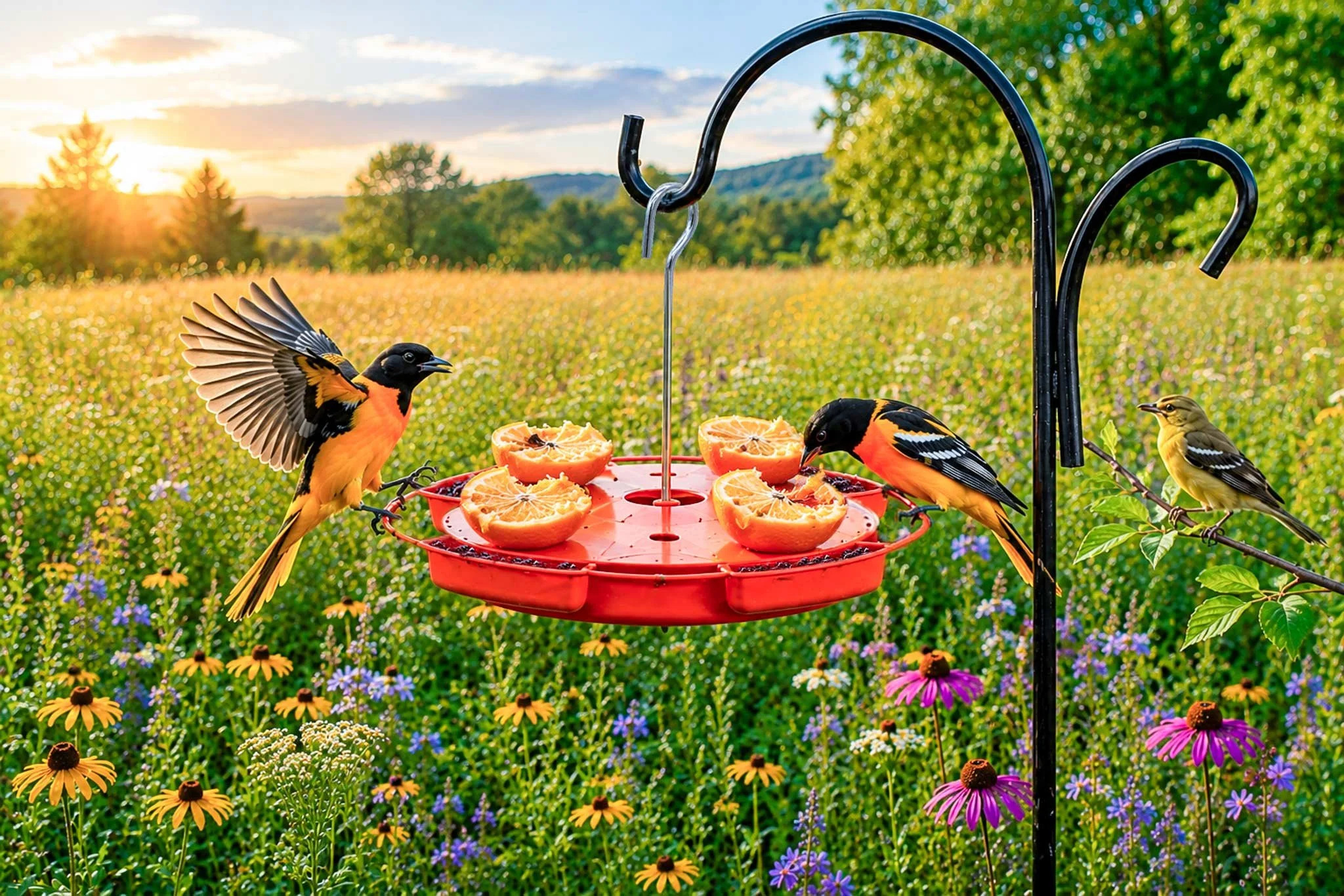
Baltimore Orioles visiting an outdoor oriole feeder stocked with fresh orange halves and grape jelly. Offering oranges, grape jelly, nectar, and mealworms is one of the best ways to attract orioles to your backyard during migration and the nesting season.
Nesting & Breeding Behavior
Orioles are known for building some of the most remarkable nests in North America. Both Bullock's Orioles and Baltimore Orioles weave hanging pouch-like nests that suspend from the outer branches of tall deciduous trees, helping protect their eggs and young from many ground predators.
Bullock's Orioles often choose cottonwoods, willows, sycamores, and other trees commonly found along rivers and open woodlands in the western United States. Their nests are woven from grasses, plant fibers, bark strips, horsehair, and occasionally soft materials such as wool or string gathered from nearby sources.
Baltimore Orioles build similar hanging nests but are more commonly associated with large hardwood trees, especially American elms, maples, oaks, and shade trees found in parks and suburban neighborhoods throughout the eastern United States. Females are the primary nest builders, spending several days carefully weaving a strong, flexible basket.
Most orioles lay 3 to 7 pale bluish-white eggs marked with dark streaks or spots. Incubation typically lasts about 12 to 14 days, with the female performing most of the incubation while the male helps defend the nesting territory and supplies food.
After hatching, both parents work together to feed the nestlings a steady diet of insects and other protein-rich foods. Young orioles usually leave the nest about 12 to 18 days after hatching but continue to depend on their parents for food and protection for several weeks as they learn to forage on their own.
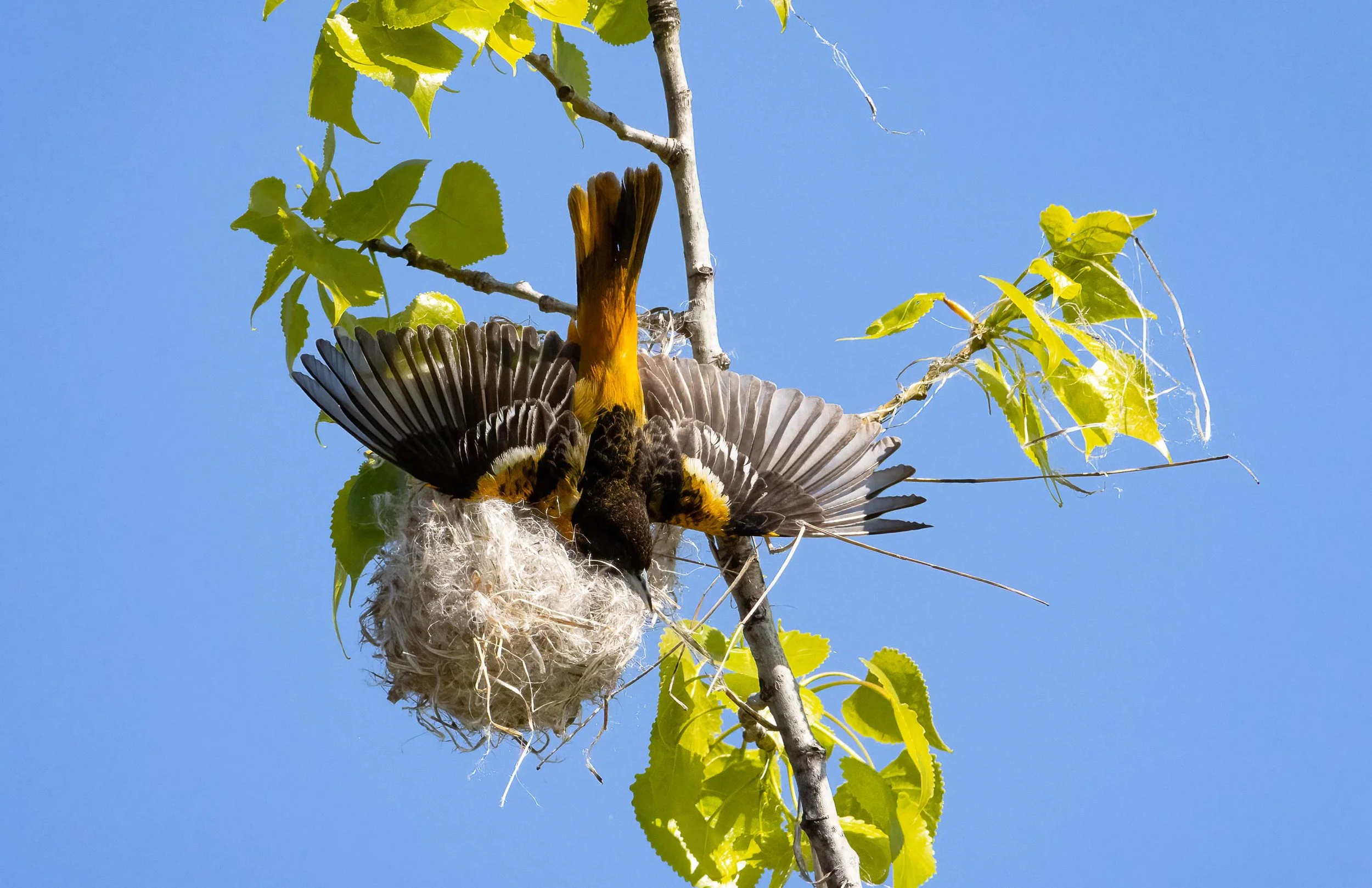
Male Baltimore Oriole building its distinctive hanging woven nest in a cottonwood tree. Bullock's and Baltimore Orioles weave pouch-shaped nests that suspend from tree branches to protect their eggs and young. Photo Courtesy of iStockphoto.com
Migration & Seasonal Movements
One of the most fascinating aspects of oriole behavior is their long-distance migration. Both Bullock's Orioles and Baltimore Orioles travel thousands of miles each year between their North American breeding grounds and warmer wintering areas in Mexico, Central America, and parts of the Caribbean.
Bullock's Orioles typically begin their fall migration from the western United States in late summer, traveling south through the Southwest into Mexico. Most return to their breeding territories between April and May, depending on weather conditions and food availability.
Baltimore Orioles follow a similar migration pattern but depart from eastern North America. Many spend the winter in southern Mexico, Central America, northern South America, and the Caribbean before returning north each spring to breed.
Spring migration is one of the best times to attract orioles to backyard feeders. Fresh oranges, grape jelly, nectar, and mealworms provide valuable energy during their long journey. Offering these foods before orioles arrive in your area can increase the chances of attracting them early in the season.
As daylight hours shorten in late summer, orioles gradually shift their diet toward sugary foods to build the energy reserves needed for migration. Once cooler weather arrives, most birds begin their journey south, returning again the following spring with remarkable accuracy to many of the same nesting territories.
Attracting Orioles to Your Backyard
One of the greatest rewards for bird lovers is watching orioles return to the same yard each spring. While no feeder can guarantee a visit, providing the right foods, fresh water, and a welcoming habitat will greatly increase your chances of attracting both Bullock's Orioles in the West and Baltimore Orioles in the East.
Set out your oriole feeders several weeks before the expected spring migration in your region. Hungry birds are actively searching for reliable food sources after their long journey north, making early-season feeding one of the best ways to establish your yard as part of their annual routine.
Orioles are especially attracted to fresh orange halves, grape jelly, nectar, and mealworms. These foods provide the carbohydrates and protein they need during migration, breeding, and while raising young. As flowering plants bloom, orioles will also feed naturally on nectar while continuing to visit backyard feeders.
Place feeders in a quiet location near mature trees or shrubs where orioles can perch safely between feeding visits. Providing a shallow bird bath or moving water source nearby will make your yard even more attractive throughout the season. Keep feeders clean, replace spoiled fruit regularly, and refresh nectar every few days during warm weather.
With a little preparation and patience, many homeowners enjoy watching these brilliant orange-and-black songbirds return year after year. Creating a bird-friendly habitat not only benefits orioles but also supports many other native songbirds and pollinators that share your backyard.
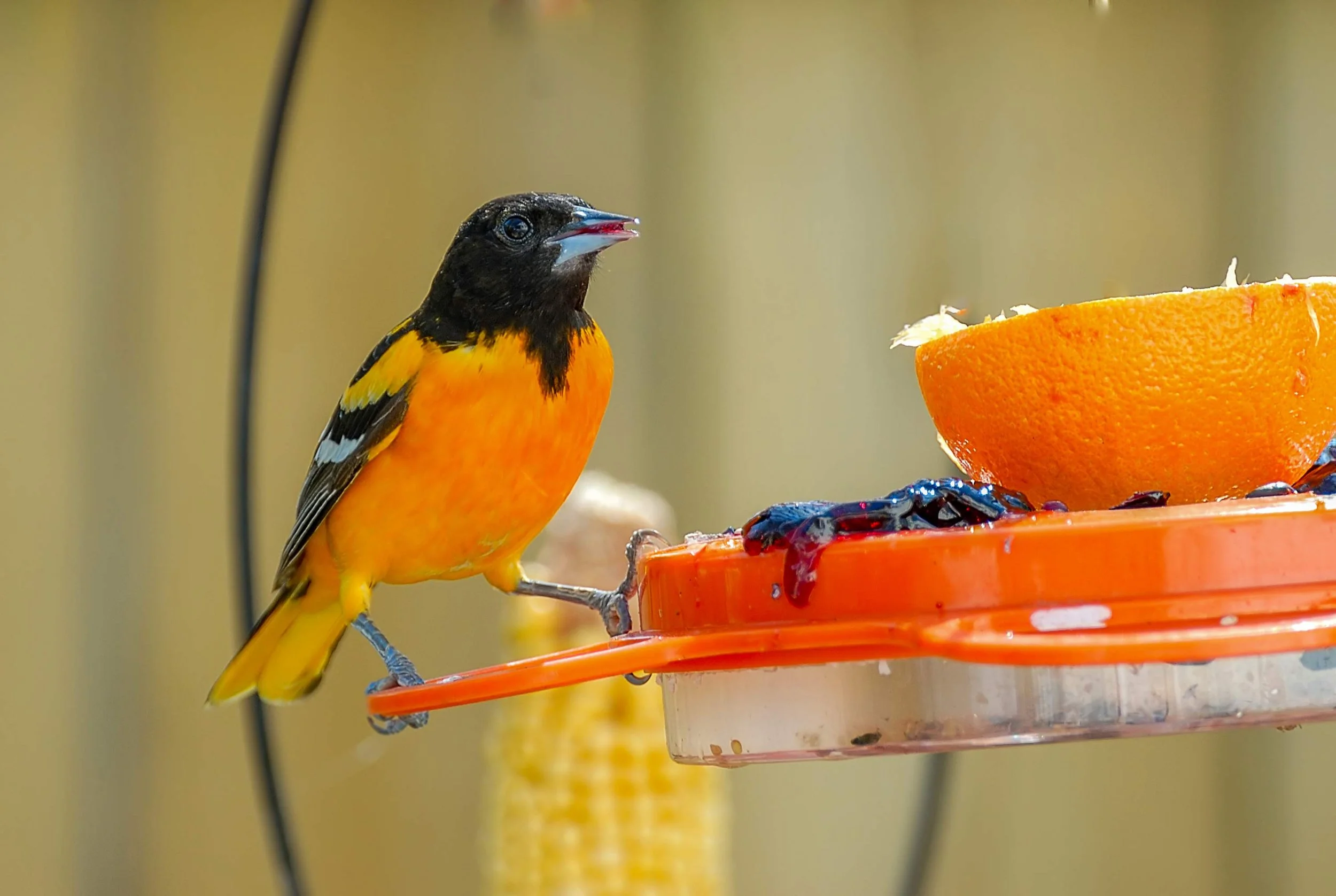
Male Baltimore Oriole feeding on fresh orange halves and grape jelly at a backyard oriole feeder, demonstrating two of the most effective foods for attracting orioles during spring migration and the nesting season. Photo Courtesy of iStockphoto.com
Frequently Asked Questions (FAQ)
Can Bullock's and Baltimore Orioles interbreed?
Yes. In portions of the Great Plains where their breeding ranges overlap, the two species occasionally hybridize, producing offspring with mixed characteristics. These hybrids are uncommon but well documented by bird researchers.
Which Oriole visits California?
Bullock's Orioles are the species most commonly found throughout California and much of the western United States. Baltimore Orioles are extremely rare in California and are usually considered unusual visitors.
What do Orioles like to eat?
Orioles enjoy insects during spring and summer, especially caterpillars, beetles, and spiders. They are also attracted to grape jelly, fresh orange halves, nectar, mealworms, berries, and other ripe fruits.
When should I put out an Oriole feeder?
Place feeders out two to three weeks before orioles typically arrive in your area during spring migration. Early food sources can help attract migrating birds as they search for reliable feeding locations.
Can Orioles use hummingbird feeders?
Yes. Orioles will often drink nectar from hummingbird feeders, although feeders designed specifically for orioles offer larger perches and feeding ports that better accommodate their size.
Final Thoughts
Bullock's Orioles and Baltimore Orioles are two of North America's most spectacular backyard birds. Although they share many similarities, differences in their appearance, range, nesting habits, migration patterns, and preferred habitats make each species unique. Learning to recognize these differences will help you identify the orioles visiting your yard and better understand their seasonal behavior.
Whether you live in the western United States watching Bullock's Orioles or in the East where Baltimore Orioles brighten forests and neighborhoods each spring, providing fresh food, clean water, and a welcoming habitat can reward you with unforgettable backyard birdwatching experiences.
At BirdFeedersRus, we're passionate about helping bird enthusiasts attract and enjoy these remarkable songbirds. Explore our selection of handcrafted and carefully chosen oriole feeders, accessories, and educational resources to create a backyard that orioles will visit year after year.
Continue Learning
Best Oriole Feeders for Your Backyard
How to Make Oriole Nectar
Orioles vs. American Robins
How to Attract Orioles with Grape Jelly
Shop BirdFeedersRus Oriole Feeders
Ready to Welcome Orioles to Your Backyard?
Bring these beautiful songbirds to your backyard with our carefully selected oriole feeders. Designed to serve fresh oranges, grape jelly, nectar, and other favorite foods, our feeders make it easy to create a welcoming feeding station that orioles will return to year after year.
Thank you for visiting the BirdFeedersRus Learning Center. We hope this guide helps you enjoy the fascinating world of backyard birds.